
Ranking Pipe Blockage Risk – Elizabeth Street Catchment

City of Melbourne / Melbourne Water
Naarm / Melbourne, Victoria
November 2023
April 2025
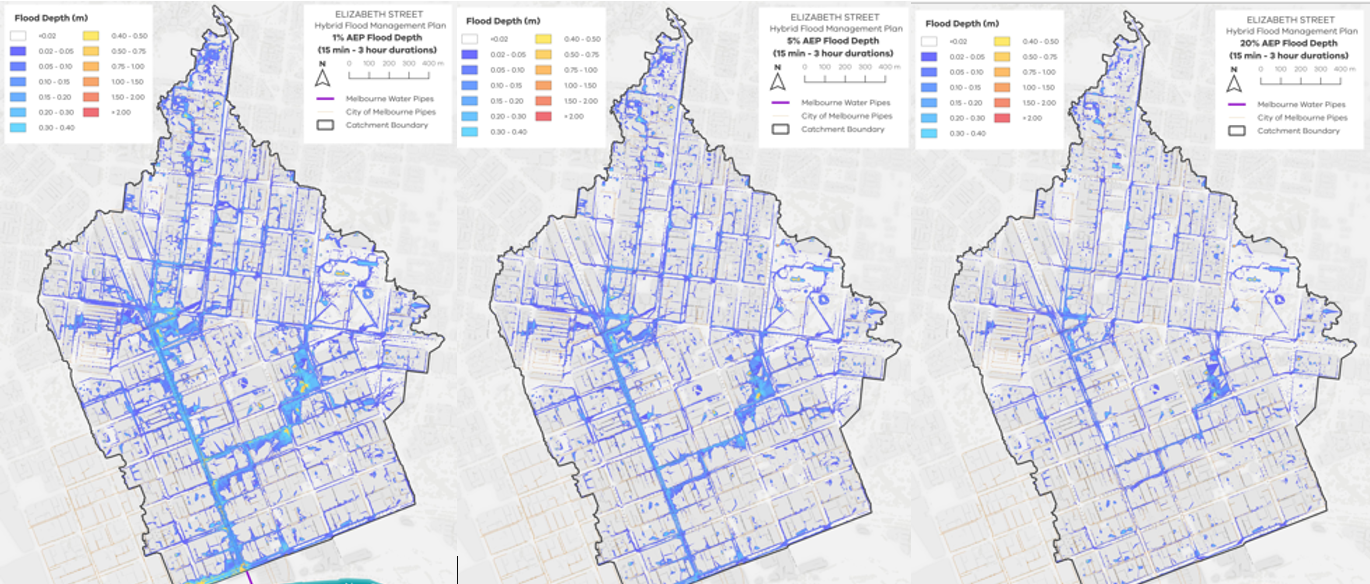
The City of Melbourne engaged Rain Consulting to prepare a Hybrid Flood Management Plan for the Elizabeth Street Catchment, one of Melbourne’s most hazardous urban floodplains. As part of the broader plan, Melbourne Water funded a Blockage Likelihood and Consequence Tool Development Trial.
The Blockage Likelihood Tool developed in this project allows council teams to target maintenance where it matters most. This ensures scarce budgets are focused on pipes where failures would pose the most significant safety and property risks, keeping the community safer between storms.
Above & Beyond Strategies
Rain developed the GIS-based Blockage Likelihood Tool and ran a focused trial in the Elizabeth Street catchment to move pipe-blockage analysis from assumption to actionable evidence.
The tool automates scoring by combining physical and environmental indicators including pipe diameter, bend angles, pipe slope, terrain slope, upstream tree density, kerb-cleaning frequency and special conditions (e.g. tramlines), into a likelihood score that is paired with a consequence score for critical locations.
We then selectively blocked pipes by likelihood category in the Elizabeth Street TUFLOW model to quantify the consequences. Key practical outputs were a spatial, GIS-linked risk ranking tool and associated scripts, so asset teams can re-run the analysis as local data change.
Blockages were found to have the greatest influence in frequent events (so maintenance protects against common storms), clustered blockages amplify impacts, and pipes in major flood paths cause the largest consequences. All pointed to targeted, risk-based maintenance close to major sources of debris as the highest-value action.
Pipes within the Medium and Low Blockage Likelihood range can be addressed in descending order of blockage score and observed for flooding patterns over time.
By adopting this prioritised approach, asset managers can maximise the efficiency and impact of maintenance efforts while reducing flood risks across the catchment.
The Elizabeth Street Catchment Trial recommends using the Blockage Likelihood Tool to identify the “highest-risk pipes”. The resulting list can then be used to prioritise maintenance works and to target cleaning before forecasted storms to minimise impacts.
This planning will allow council teams to target maintenance where it matters most.
Rain’s Blockage Likelihood Tool is part of a comprehensive Hybrid Flood Management Plan delivered to the City of Melbourne in April 2025. The tool is on a ‘Short List Roadmap’ of immediate recommended actions.
Flood resilience for the Elizabeth Street Catchment is no longer a distant aspiration. The hybrid approach, the toolkit, the short list of projects, and the Blockage Likelihood Tool together present a clear, actionable pathway.


