
Hybrid Flood Management Plan – Elizabeth Street Catchment

City of Melbourne
Naarm / Melbourne, Victoria
November 2023
April 2025
The Elizabeth Street Catchment Hybrid Flood Management Plan was the recipient of the 2026 Stormwater Victoria Highly Commended Award in the Excellence in Strategic or Master Planning category.
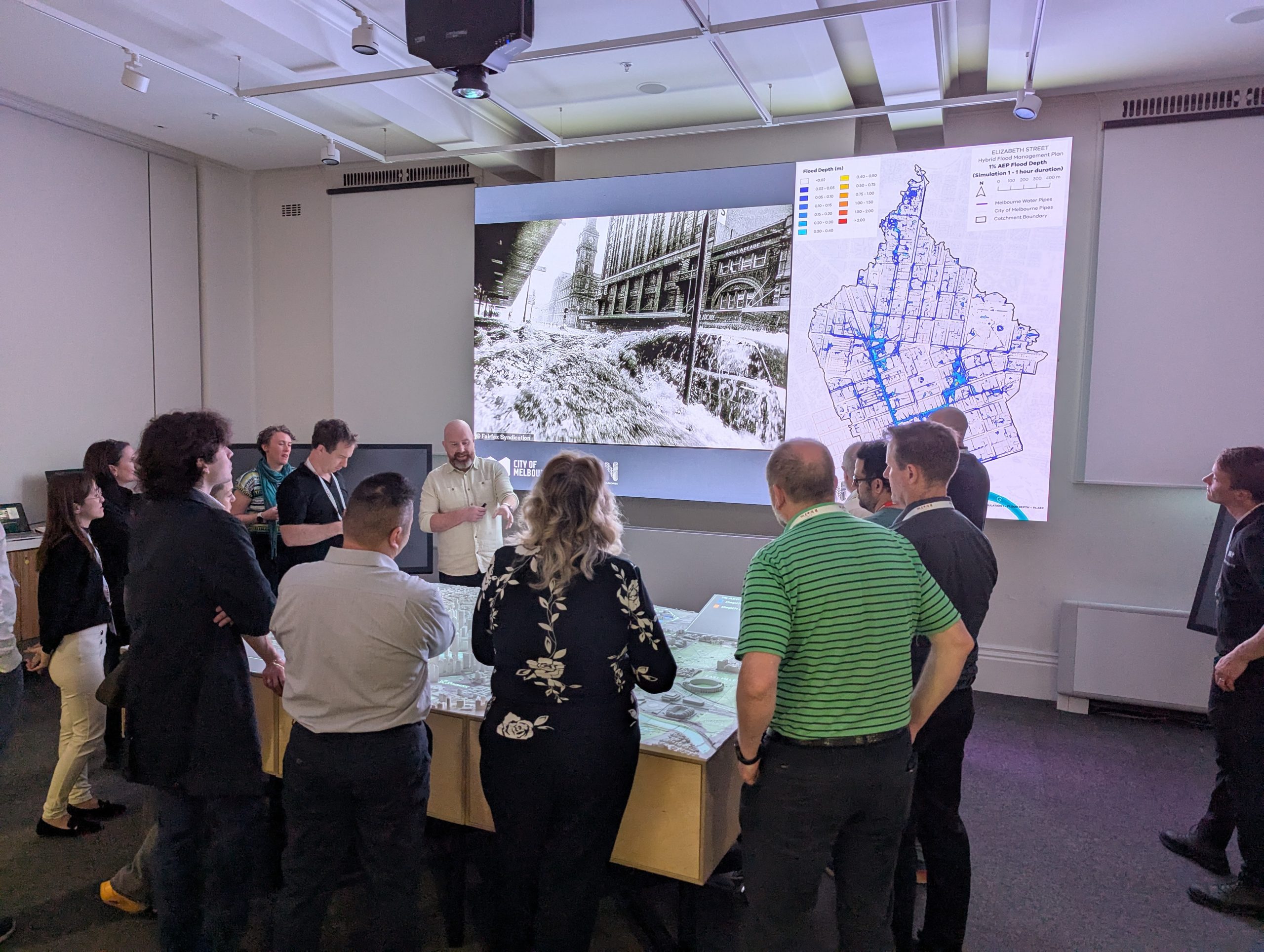
In 2025, Rain Consulting delivered a Hybrid Flood Management Plan for the Elizabeth Street Catchment, one of Melbourne’s most complex and hazardous urban floodplains. The plan takes a catchment-wide approach, blending traditional drainage upgrades with nature-based interventions and policy mechanisms. The project aims to showcase how cities can coexist with water by building resilience, reducing risk, and aligning with broader city objectives for integrated water management.
Above & Beyond Strategies
The Elizabeth Street Catchment faces dangerous, high-velocity flooding caused by steep gradients, dense development, and a buried waterway beneath the CBD.
Traditional flood mitigation measures alone have proven insufficient, especially with increasing rainfall intensities due to climate change and ongoing urbanisation. The main challenge was to deliver practical, high-impact solutions within a heavily built-up and constrained environment, while preparing for more frequent and extreme flood events.
Rain delivered the following solutions.
- Integrated conventional engineering and nature-based solutions into a “hybrid” approach.
- Updated flood modelling for climate conditions up to 2100, including the latest rainfall intensity uplifts.
- Developed and tested a broad toolkit of mitigation options tailored to sub-catchment conditions.
- Collaborative engagement with the Melbourne City Council to prioritise interventions and test modelled outcomes.
- Delivered a short list of constructable, high-performance hybrid interventions.
- Achieved flood depth reductions of up to 80% in key locations.
- Significantly reduced flood hazard, including up to four hazard category reductions in critical CBD areas.
- Demonstrated the importance of permeable paving, local detention, and strategic policy as complements to traditional drainage.
- Clarified cost estimates and staged implementation pathways for Council planning.
- Outlined non-structural measures, including emergency management, signage, community education, and policy reform.
Rain Consulting’s plan confirmed that a layered, adaptive hybrid strategy could deliver major reductions in flood depth and hazard, even in Melbourne’s most challenging urban catchment.
The modelling proved up to 80% flood depth reduction and hazard reductions of up to four categories in the CBD’s riskiest locations. The work established a new benchmark for integrating engineering, green infrastructure, and smart policy to achieve city-scale flood resilience.
The report recommends revisiting the interventions using the latest climate change projections (ARR4.2) in the next phase of detailed design and delivery. It calls for staged implementation, integration with capital works programs, and ongoing adaptation as new information and climate conditions emerge. Council is encouraged to embed the hybrid approach into its policies, asset management, and community education initiatives.


